


.png)
WHAT IS AI BROKER IN MAS?
AI Broker acts as a bridge between AI models and operational applications.
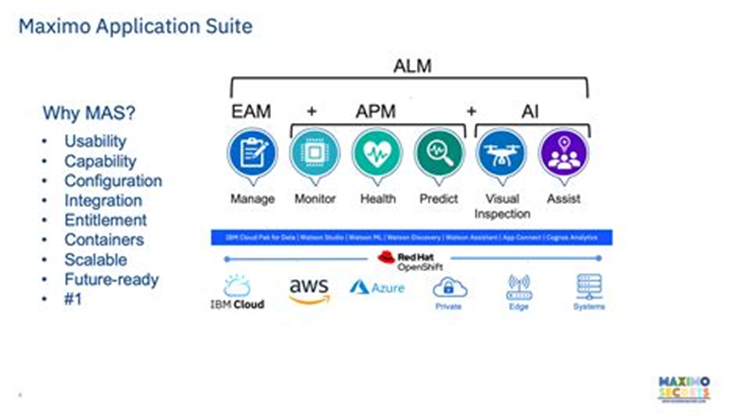
It connects AI insights (from Monitor, Visual Inspection, Predict, etc.) to businesslogic in Maximo, enabling automated actions to execute seamlessly.
In practice: when an anomaly or threshold breach is detected on a monitored asset,AI Broker can trigger a Python automation script within MAS—instantly generating a Work Order, alerting teams, or adjusting asset maintenance schedules.
Result: autonomous maintenance workflows that operate 24/7 without human oversight.
─────────────────────
PYTHON AUTOMATION IN MAS: UNLOCKING FLEXIBLE WORKFLOWS
IBM Maximo's Python (Jython) scripting engine enables automation without modifyingcore application logic.
Developers can dynamically create Work Orders, notifications, or maintenance actionsbased on real-time data or events.
Common automation use cases:
→ Automatically generate Work Orders upon anomaly detection→ Schedule preventive maintenance based on AI predictions→ Integrate IoT data streams into maintenance workflows→ Dynamically adjust work order priorities based on asset criticality
─────────────────────
PRACTICAL EXAMPLE: AUTOMATIC WORK ORDER CREATION
Here's how Python automation responds to an AI Broker alert:
from psdi.server import MXServer

from psdi.mbo import MboRemote


# Connect to Maximo server and retrieve system user

mxServer = MXServer.getMXServer()

userInfo = mxServer.getSystemUserInfo()


# Create Work Order set

woSet = mxServer.getMboSet("WORKORDER", userInfo)


# Add new Work Order triggered by AI event

newWO = woSet.add()

newWO.setValue("DESCRIPTION", "AI Alert: Pump P-1001 anomaly detected")

newWO.setValue("ASSETNUM", "P-1001")

newWO.setValue("WOPRIORITY", 1)  # High priority

newWO.setValue("WORKTYPE", "CM")  # Corrective Maintenance

newWO.setValue("SITEID", "MAINPLANT")


woSet.save()

print("Automated Work Order created via AI Broker trigger")
─────────────────────
HOW IT WORKS END-TO-END
- AI model receives operational data (sensor readings, equipment logs, etc.)
- Model detects anomaly or threshold breach
- AI Broker receives alert and evaluates trigger conditions
- Python automation script is invoked instantly
- Script creates Work Order with relevant context (asset, priority, type, etc.)
- Maintenance teams are notified and respond immediately
Timeline: Detection to Work Order creation happens in seconds.
─────────────────────
BUSINESS BENEFITS
✓ Autonomous Work Order creation based on AI insights—no manual intervention✓ Reduced downtime through instant response to asset anomalies✓ Seamless integration between AI, IoT, and EAM systems✓ Scalable automation without modifying Maximo core logic✓ Improved asset reliability and operational efficiency✓ Reduced labor overhead in reactive maintenance tasks
─────────────────────
INTELLIGENT MAINTENANCE: THE FUTURE IS NOW
The synergy between AI Broker and Python scripting represents a fundamental shift inhow organizations approach asset management.
Companies evolve from reactive maintenance (responding to failures) to predictivemaintenance (anticipating failures) to autonomous maintenance (self-managing assetswith AI guidance).
This progression is no longer theoretical—it's operational reality for organizationsleveraging MAS 9.1 capabilities.
If you're managing complex assets and want to explore autonomous maintenance workflows,the foundation is already in place.
.png)